Tuesday, November 20, 2012

The pros and cons of rent-to-own

By Mark Weisleder - a lawyer, author, instructor, columnist and keynote speaker for the real estate industry.
Original article can be found here


The changes to the mortgage rules announced by Finance Minister Jim Flaherty last July are making it more difficult for first time buyers to get approved for a mortgage. Other buyers may have good credit but not enough of a down payment. At the same time, landlords are looking for good tenants to rent their units. Rent-to-own may provide a win-win for both owners and tenants.


Here’s how it works:
A landlord rents the home or condominium under a basic home lease. For an extra payment, the tenant receives an option to buy the home at a later date, for a set price. Let’s say the home is worth $250,000. The parties agree the tenant will have the right, but not the obligation, to buy the house in three years for $280,000.
The fee for this right, or option, is usually 2 or 2 ½ per cent of the final price. In this example, 2 percent of $280,000 would be $5,600. Then, each month, the tenant pays an extra fee, say $200, that also is applied to this option price. At the end of the three-year lease term, the tenant has put up close to 5 per cent towards the purchase price option. In this example, it would be close to $13,000.
If the tenant exercises their right to buy, they can use the $13,000 as the down payment and apply for a mortgage to finance the rest of the purchase.
Here are some of the advantages for the tenant:
•You may not have the down payment now, but you will have it at the end of your lease, as a result of the additional payments;
•If your credit is not good, you can improve it by making timely payments of rent;
•You can try out the neighbourhood and if you change your mind later, you can just cancel the option;
•If the market price of this home is more than $280,000 at the end of your lease, you still get to buy it for the same $280,000.
•If the market collapses and the home is worth less than $280,000, you do not have to go through with your purchase.
Here are some disadvantages:
•There is no guarantee that a bank will give you your financing when you exercise your option. You still have to improve your credit score or find someone to co-sign your application;
•If you don’t go ahead with your purchase, you usually have to forfeit the option payment.
Here are some advantages for the landlord:
•Tenants on rent-to-own typically take better care of the property, thinking that they may own it one day;
•Your profit is fixed at the time of the option.
Landlords need to make sure that the option payment is covered in a separate agreement, and is not included in the lease. If it is included in the lease and then the tenant defaults, it can be harder to evict the tenant from the property. Landlords also need to conduct a thorough credit and background check, to make sure that the tenant looks like they will have the means to make all of the required payments.
Rent to own can work for landlords and tenants if you are properly prepared in advance.

Friday, November 16, 2012

Housing Market Outlook Q4 2012


New Housing Market outlook is out and there are not too many surprises. We peaked in Q2 of 2012 and the rest of the year is expected to be slow, but steaddy

In the first half of 2012, the level of new listings increased, leading to the emergence of balanced market conditions by the second quarter of 2012. However, the growth of new listings is expected to moderate over the second half of 2012, in response to moderating price growth, and to stabilize in 2013

MLS® sales are forecast to essentially hold steady in 2012 before moving slightly higher in 2013 due to employment growth and low interest rates. For 2012, MLS® sales are expected to be between 449,200 and 465,600 units. In 2013, MLS® sales are expected to be between 433,300 and 489,700 units.

Ontario housing demand is expected to have peaked during the second quarter of 2012 and to moderate over the forecast horizon. Total starts will reach 77,600 units in 2012 before moderating to 65,000 units in 2013. Modest job growth relative to the recent past, better supplied resale markets and a high level of new units under construction are expected to pull Ontario home starts back.

Heightened global uncertainty is expected to dampen business investment and job creation to levels below historical norms over most of the forecast horizon. Low average job growth will continue to hold back consumer spending. However, some leading indicators suggest that the US consumer is starting to spend with both housing and vehicles sales trending higher in recent months. Based on historical data, Ontario’s south western and northern Ontario economies are most responsive to this positive change in these US industries.

A widening economic growth gap between Ontario and the rest of Canada suggests Ontario will continue to lose migrants to other provinces in the short term. However, international migration will provide some support to Ontario population growth.


Key Factors and their Effects on Housing Market Activity

Mortgage Rates 

Short-term mortgage rates and variable mortgage rates are expected to remain near historically low levels, which will help support housing demand. The outlook’s base case also assumes that mortgage rates will remain flat in 2012 and rise modestly in 2013.

Employment

In the 12 months to September 2012, employment grew by 1.0 per cent (+174,500), while the unemployment rate stood at 7.4 per cent. Over this period, full-time employment rose 1.1 per cent (+156,800), and part-time rose 0.5 per cent (+17,700). Employment is forecast to grow 1.1 per cent in 2012 and 1.9 per cent in 2013, which will support Canada’s housing sector.

Vacancy Rates

Vacancy rates across Canada’s metropolitan centres are expected to hold steady at 2.2 per cent in 2012 before declining to 2.0 per cent in 2013, reflecting expectations of modest purpose-built rental construction and strong rental demand due to high immigration. Low vacancy rates are expected to help support the multiple starts housing segment, through expansion of the rented condominium market.

Changes to Mortage Insurance Rules

The recent measures for government-backed mortgage insurance will help ensure the sustainability of housing market activity and help stabilize house price growth. New measures announced for government-backed mortgage insurance will moderate housing activity. Some potential buyers will have to save a larger down payment to offset shorter amortization periods and thus postpone their purchase or consider a less expensive home.

Stock of New and Unoccupied Units

The stock of unoccupied new housing units has been stable in 2012, indicating continued strength in demand for newly completed homes. In addition, the ratio of the stock of unoccupied new units to population, a simple gauge to assess potential over-building, is close to the historical average. Should the inventory increase inordinately, builders may delay or reduce the size of some housing projects. This could lead to a sharper-than-expected moderation.

Read full report

Monday, November 5, 2012

Toronto Market Watch: October


 Greater Toronto Area REALTORS® reported 6,896 transactions through the Toronto MLS system in October 2012 – a decrease of 7.1% compared to October 2011.

“Sales have decreased in the second half of this year compared to 2011, especially since the onset of stricter mortgage lending guidelines at the beginning of July. The prospect of higher monthly mortgage payments due to the reduced maximum amortization period has prompted some households to delay their home purchase,” said Toronto Real Estate Board (TREB) President Ann Hannah.


The average selling price for October transactions was $503,479 – up 6.2% compared to October 2011. The MLS® Home Price Index composite benchmark price, which allows for an apples-to-apples comparison in terms of home attributes, was up by 5.1 per cent.


“We continue to see price increases well above the rate of inflation. Active listings have remained low from a historic perspective, so substantial competition between buyers still exists, especially for low-rise homes,” said Jason Mercer, TREB’s Senior Manager of Market Analysis.

“It should be noted, however, that the annual rate of price increase has been edging lower over the past few months as the market has gradually become better supplied,” continued Mercer.


Friday, October 19, 2012

What the Heck is Title Insurance?


Title insurance is an insurance policy that protects you, the homeowner from problems related to the title to your home. Risks that are covered under title insurance include claims due to fraud (if person who sold it to you will be found guilt of fraud and therefore not a lawful owner of the property); work orders and liens (ex: if previous owner did not pay contractors); undischarged mortgages, zoning and setback non-compliance, survey irregularities, permit violations, fences, boundaries, tenancies, rights of way, certain easements and many others, but the most common one is probably utility bills unpaid by previous owner
      What Does Title Insurance Not Cover?
  • Damages due to flooding, fire or sewer backup;
  • General wear and tear of your home (e.g. replacing old windows, a leaky roof, or an old furnace)
  • Theft (e.g. a burglar breaks into your home and steals your television); and
  • Other losses or damages due to nontitle related issues.
     What are the Different Types of Title Insurance?     
     There are two main types of title insurance policies:
Owner’s policy – Protects the property owner from various title related losses that are listed in the insurance policy, for as long as the property is owned. An owner’s policy sets a maximum amount of coverage.
Lender’s policy – Protects the lender from losses in the event that the property’s mortgage is invalid or unenforceable. A lender’s policy usually provides coverage for the amount of the property’s mortgage.
        What type of properties can be covered?
Tile insurance is offered on all types of properties including single family residences, apartment buildings, mixed-use properties, agricultural properties, vacant land, warehouses, railways, office buildings, entertainment complexes, retail outlets, distribution centres and hotels. In fact, title insurance is even more important for commercial real estate transactions where typically the risks are greater and loan amounts larger.
      How long does the coverage last?
Residential title insurance coverage lasts as long as you own the property. Most residential title insurance policies extend coverage to your heirs through a will, to a spouse in the event of a divorce, or to children when the property is transferred from parents to children for nominal consideration.


Friday, October 12, 2012

Toronto Market Watch: September


Greater Toronto Area (GTA) REALTORS® reported 5,879 transactions through the Toronto MLS system in September 2012. The average selling price for these transactions was $503,662, representing an increase of more than 8.5% compared to last year.

The number of transactions was down by 21% in comparison to September 2011. However, it is important to note that there were two fewer working days in September 2012 compared to September 2011. The majority of transactions are entered on working days. On a per working day basis, sales were down by 12.5% year-over-year.


Condo prices continue to suffer, combine it the 3rd month of dropping sales (27% average this month) and you will see that market is adjusting itself in that area. Though 416 area condo apartments price increase was 8% vs. year ago; 905 are is at just 1% compared to last September. We hear from many lenders, including credit unions that they are no longer offering mortgages with less than 35% down on any apartment condos south of HWY 401. When it gets harder to get financing, you have less buyers and less sales. This could explain (on top of other reasons) the decline on condo market

Townhouses did surprisingly bad in both 416 and 905 area with only 6% price increase on average. Highest price increase was seen in semi-detached houses - 12% on average. 


“While sales have been lower due to stricter mortgage lending guidelines, we continue to see substantial competition between buyers. The months of inventory trend remains low from a historic perspective, which explains the strong price increases we are experiencing,” said Toronto Real Estate Board (TREB) President Ann Hannah.

“Barring a major change to the consensus economic outlook, home price growth is expected to continue through 2013. Based on inventory levels, price growth will be strongest for low-rise home types, including single-detached and semi-detached houses and town homes,” said TREB’s Senior Manager of Market Analysis, Jason Mercer.

Read full report

Tuesday, October 9, 2012

Is ‘Manhatannization’ of Toronto Really Here?

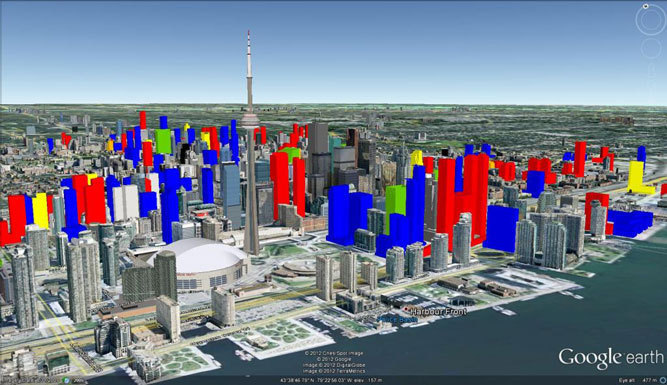
One of 5 Corners' partner in Real Estate - Nikolay Klyushkin posted and interesting article about developments in Toronto. Do you think Toronto will be a Northern Apple? Just look at all the new buildings planned for the next 10 years


This is not new that Toronto is building  more skyscrapers than any other city in North America.
The total number of condo buildings (high and low rises and skyscrapers) under construction is 184 according to Emporis, provider of building and construction data. And despite all talks and warnings of a Canadian real estate bubble, there are hundreds planned to be built.
Going through the multiple Internet forums I came across the artwork of this young 17 year old guy named named Cale Vanderveen who really impressed me with his vision and superb images of new developed Toronto city.
Check them out here and here are the guidelines:
  • WHITE = the project has had preliminary renders, but no application has been submitted.
  • RED = the project has submitted an application to the city
  • GREEN = the project has been approved, but has yet to start construction
  • YELLOW = the project is currently in sales
  • BLUE = the project is currently under construction

Entertainment district:

View from DVP in 10 years:

Yorkville:

New skyline:

Friday, October 5, 2012

How to avoid or minimize penalty when breaking a mortgage


If you’re getting a new long-term mortgage,  odds are you will consider making changes before maturity. The majority of people will either:
•    Add money to their mortgage
•    Add a secured  line of credit
•    Refinance to get a better rate (which happens less frequently nowadays)
•    Increase the amortization
•    Port their mortgage to a new home, or
•    Discharge it outright.


Some of the above will require an early pre-payment charge (penalty). Even though  major banks have lower funding costs sometimes they charge more than twice of what a smaller lender would charge for the same term mortgage. Some times penalties could be tens of thousands of dollars and it's important to know about them regardless if property is your home or an investment.

Here are some questions to ask a lender about its penalty:


If I break the mortgage and stay with you, will you forgive a percentage of my penalty or apply unused prepayment privileges, to reduce my penalty? 

More lenders are doing this as competition grows.


If not, can I make a prepayment a few weeks before breaking my mortgage to lower the balance used to calculate my penalty? 
When determining a penalty, some lenders refuse to consider prepayments 30-90 days before you request to discharge.

Can I increase my mortgage without a penalty? 

This is important if you ever upgrade your property or need additional funds.


If I sell my property and port my mortgage to a new one, how long can I take to close on that new property and still avoid a penalty? 
Some lenders unreasonably require you to close your old and new home on the same day, others are willing to wait for up to a month.


Can I get out of my fixed mortgage early if I pay a penalty? 
Some “low frills” closed mortgages don’t let you out before maturity – no matter what – unless you sell your home. On a flexible mortgage on another hand, most of the times you only need to pay 3 months interest to break a mortgage.

Do you charge IRD (The IRD is a compensation charge that may apply if you pay off your mortgage prior to the maturity date, or pay the mortgage principal down beyond the amount of your prepayment privileges) penalties on your variable-rate mortgage, as opposed to the standard three-month interest? 

Despite being highly unorthodox, a few lenders actually do this and it can cost you.

How long will you honor your IRD penalty quote? 

This is relevant if you’re trying to discharge a fixed-rate mortgage while rates are dropping. Falling rates can increase your IRD penalty.

By March 5th, 2013 industry will go a step further by requiring banks to provide annual information that will help consumers calculate their penalty, written penalty statements upon request with clear calculation explanations, and access to exact prepayment penalty quotes by phone.